

Xenon Gas Properties
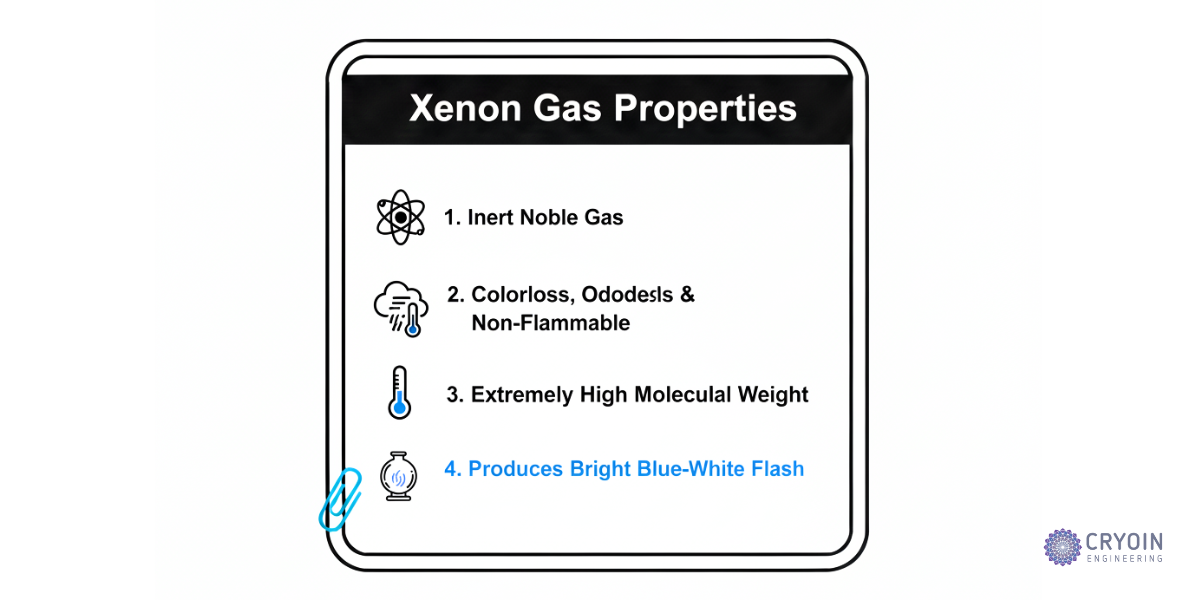
Xenon exhibits physical and chemical properties that distinguish it from lighter noble gases and make it suitable for high-performance technical applications.
- Atomic number: 54
- Atomic weight: 131.29
- Electron configuration: [Kr] 4d¹⁰ 5s² 5p⁶
- Melting point: −111.8 °C
- Boiling point: −108.1 °C
- Density (at STP): 5.894 kg/m³
- Chemical reactivity: Very low
Xenon is significantly denser than air and other noble gases such as neon and helium. When electrically excited, xenon emits intense light across a broad spectral range, including ultraviolet and visible wavelengths. Although generally inert, xenon can form stable compounds under extreme laboratory conditions, primarily with fluorine and oxygen.
What Is Xenon Used For?
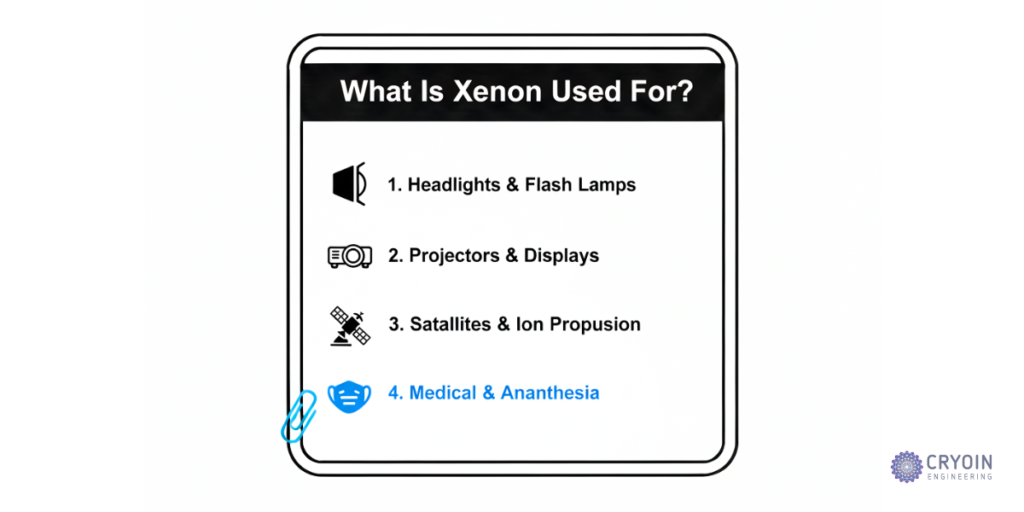
Xenon is a strategic gas applied in industries where high energy output, optical efficiency, and system stability are essential.
High-Intensity Lighting and Projection
Xenon is widely used in high-intensity discharge (HID) lamps, including automotive headlights, cinema projection systems, stadium lighting, and searchlights. Xenon-based illumination devices generate bright white light with excellent color rendering and stable intensity during long operating cycles.
Medical Applications and Anesthesia
In medical practice, xenon serves as an inhalation anesthetic due to rapid induction, fast recovery, and minimal cardiovascular impact. Xenon is also applied in advanced diagnostic imaging, particularly in lung ventilation studies and neurological research.
Advanced Photonic and Radiation Systems
Xenon functions as a working medium in excimer-based radiation sources and pulsed optical discharge systems used in semiconductor fabrication, precision medical equipment, and scientific instrumentation. High-purity xenon ensures consistent plasma characteristics and stable radiation parameters.
Space and Electric Propulsion Systems
Xenon is the preferred propellant for ion-based thrusters and Hall-effect engines used in satellites and deep-space missions. Its high atomic mass enables efficient momentum transfer, making xenon ideal for long-duration electric propulsion systems.
Semiconductor Manufacturing
In semiconductor production, xenon is utilized in plasma-assisted etching, deposition technologies, and radiation-driven lithographic processes. Ultra-high-purity xenon is required to maintain contamination-free environments and ensure precise micro-scale pattern formation.
Scientific Research and Radiation Detection
Xenon is widely used in particle physics, radiation detection, and nuclear research. Liquid xenon detectors provide high sensitivity and are employed in experiments investigating dark matter and fundamental particle interactions.
Xenon Gas History

Xenon was discovered in 1898 by William Ramsay and Morris Travers during research on liquefied air. The element was named after the Greek word meaning “stranger,” reflecting its rare and unexpected presence.
For many years, xenon was considered chemically inactive and of limited practical significance. However, advancements in illumination technologies, aerospace systems, and medical science during the 20th century revealed its exceptional industrial and scientific value.
Industrial High Purity Xenon Gas
Modern industrial and scientific applications require ultra-high purity xenon, as even minimal impurities can influence optical performance, plasma behavior, propulsion efficiency, and detector sensitivity.
Cryoin Engineering supplies xenon gas with purity levels reaching up to 99.9999%, suitable for critical industrial and research environments.
- Ultra-high-purity xenon for demanding industrial and scientific applications
- Advanced purification technologies and analytical quality control
- Worldwide distribution and logistics support
- Flexible supply volumes from laboratory scale to large industrial quantities
- ISO 9001:2015 certification confirming compliance with international quality standards for rare gas production
FAQ
What Is High Purity Xenon?
High-purity xenon is refined xenon gas purified from oxygen, nitrogen, moisture, hydrocarbons, and other trace contaminants. Purity levels may reach 99.9999% depending on technical requirements.
How Many Electrons Does Xenon Have?
Xenon contains 54 electrons arranged in a stable configuration with a complete outer electron shell.
When Was Xenon Discovered?
Xenon was discovered in 1898 by William Ramsay and Morris Travers during experiments involving liquefied air.
Why Choose High-Purity Xenon Gas?
High-purity xenon ensures stable optical emission, efficient electric propulsion, high detector accuracy, and reduced contamination risks in semiconductor manufacturing.
Is Xenon Reactive?
Xenon remains largely inert under standard industrial conditions, forming compounds only under highly controlled laboratory environments.

Leave a Reply