

Helium gas is a noble gas and chemical element with the symbol He and atomic number 2. It is colorless, odorless, tasteless, non-toxic, and chemically inert. Helium is the second-lightest element in the periodic table and the second-most abundant element in the universe after hydrogen.
Despite its cosmic abundance, helium is relatively rare on Earth. It is primarily found trapped in natural gas reservoirs, where it forms from the radioactive decay of heavy elements such as uranium and thorium. Due to its low density, helium easily escapes Earth’s atmosphere, making industrial extraction and conservation critical.
Helium’s unique physical and chemical properties make it an irreplaceable resource for advanced technologies, scientific research, medical systems, and high-precision industrial processes.
Helium Gas Properties
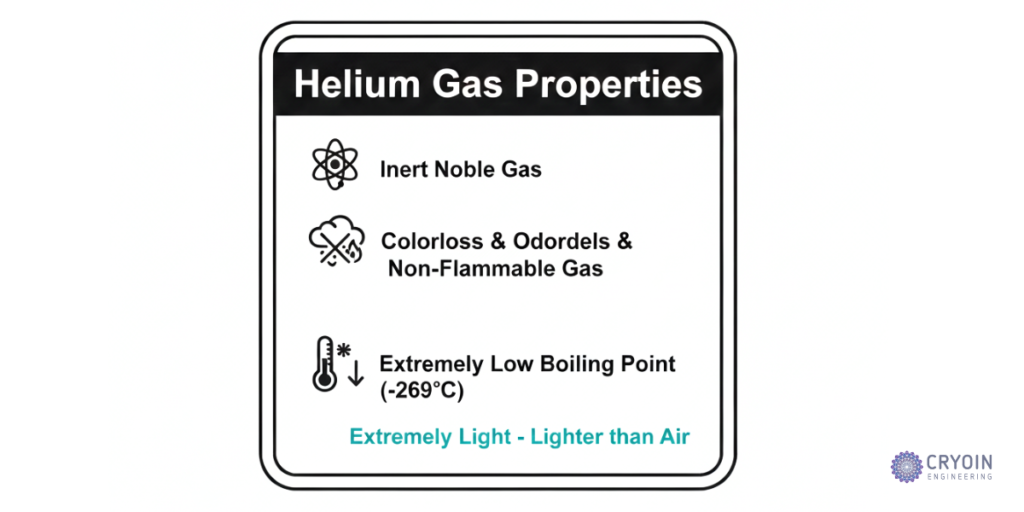
Helium possesses a combination of properties unmatched by any other element, especially in low-temperature and high-purity applications.
- Atomic number: 2
- Atomic weight: 4.0026
- Electron configuration: 1s²
- Boiling point: −268.9 °C (the lowest of all elements)
- Critical temperature: −267.9 °C
- Melting point: Does not solidify at atmospheric pressure
- Density (at STP): 0.1785 kg/m³
- Chemical reactivity: Extremely low
Helium remains liquid only at temperatures near absolute zero and does not freeze unless subjected to very high pressure. This makes it the most effective cryogenic coolant available. Its monatomic structure and complete electron shell ensure exceptional stability and zero chemical interaction with other materials.
What Is Helium Used For?
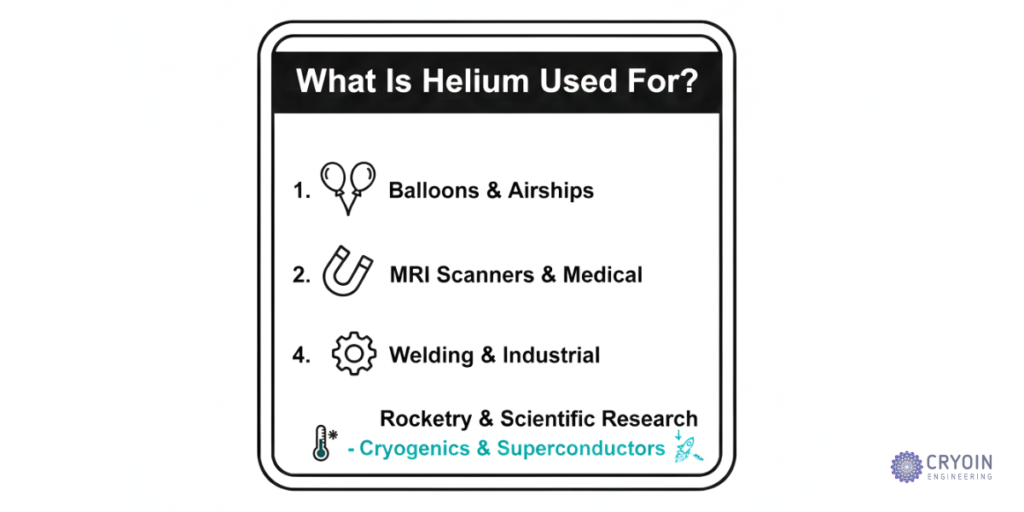
Helium is a strategic industrial gas with applications spanning high technology, medicine, science, and manufacturing.
Cryogenics and Superconductivity
Helium is the primary cryogenic medium for cooling superconducting systems. Liquid helium is essential for maintaining the ultra-low temperatures required for superconducting magnets in MRI scanners, particle accelerators, fusion reactors, and advanced research facilities.
No alternative substance can provide the same performance range.
Medical and Healthcare Applications
In medical technology, helium plays a critical role in magnetic resonance imaging (MRI) systems, where stable superconductivity is mandatory. Helium is also used in respiratory treatments, where helium–oxygen mixtures reduce airflow resistance and improve breathing efficiency for patients with obstructive airway conditions.
Semiconductor and Microelectronics Manufacturing
High-purity helium is widely used in semiconductor fabrication processes, including plasma etching, deposition, and lithography. It serves as a carrier gas, purge gas, and cooling agent, helping maintain stable temperatures and ultra-clean environments required for modern microchip production.
Leak Detection and Vacuum Technology
Helium is the global standard for high-sensitivity leak detection. Due to its small atomic size and inert nature, helium easily penetrates microscopic leaks. Helium mass spectrometers can detect leaks at extremely low rates, making this method indispensable for vacuum systems, pressure vessels, pipelines, and high-reliability components.
Aerospace and Space Exploration
In aerospace applications, helium is used to pressurize rocket fuel tanks, purge propulsion systems, and stabilize sensitive equipment. Its low density and chemical inertness make it ideal for extreme conditions encountered during launch and space missions.
Welding and Metal Processing
Helium is used as a shielding gas in arc welding, particularly for aluminum, copper, and other non-ferrous metals. Compared to argon, helium provides higher arc temperatures, deeper penetration, and improved weld quality in thick materials.
Scientific Research and Analytical Equipment
Helium is essential for gas chromatography, mass spectrometry, spectroscopy, and low-temperature physics experiments. High-purity helium ensures stable carrier flow, accurate detection, and reproducible analytical results in laboratory environments.
Helium Gas History
Helium was first identified in 1868 during observations of a solar eclipse by the French astronomer Jules Janssen and, independently, by the British astronomer Joseph Norman Lockyer. A previously unknown spectral line in sunlight led to the discovery of a new element.
Helium was later isolated on Earth in 1895 by Sir William Ramsay, confirming its presence on Earth. Throughout the 20th century, helium became increasingly important as cryogenic science, aerospace engineering, and medical imaging technologies developed.
Industrial High Purity Helium Gas
Modern industrial and scientific applications require high-purity helium, as even minimal contamination can compromise system performance, measurement accuracy, or equipment lifespan.
Cryoin Engineering supplies industrial helium gas with a high degree of purification, meeting the strict requirements of advanced technologies. Typical purity grades range from 99.999% to 99.9999%, depending on application needs. The company offers:
- Helium gas with maximum achievable purity levels suitable for cryogenic and electronic applications
- Advanced purification and analytical quality control processes
- Worldwide sales and shipping
- Availability in any required volume, from laboratory cylinders to bulk industrial supply
- ISO 9001:2015 certification, obtained in 2016, confirming compliance with international quality management standards for rare gas production
Cryoin Engineering’s high-purity helium is optimized for use in medical equipment, semiconductor manufacturing, aerospace systems, and scientific research, where consistency, safety, and reliability are essential.
FAQ
What Is High Purity Helium?
High-purity helium is helium gas refined to remove moisture, oxygen, nitrogen, hydrocarbons, and other trace contaminants. Typical purity grades range from 99.999% to 99.9999%, depending on application needs.
How Many Electrons Does Helium Have?
Helium has 2 electrons, which completely fill its outer electron shell. This configuration gives helium exceptional chemical stability.
When Was Helium Discovered?
Helium was discovered in 1868 through solar spectroscopy and later isolated on Earth in 1895.
Why Choose High-Purity Helium Gas?
High purity helium ensures:
- Stable cryogenic cooling
- Accurate leak detection
- Reliable semiconductor processing
- Safe medical and research operations
Low-purity helium can introduce contamination and reduce system efficiency.
Is Helium Reactive?
No. Helium is chemically inert and does not form stable compounds under normal industrial or laboratory conditions.

Leave a Reply