

Krypton occupies an intermediate position between lighter noble gases such as neon and heavier ones such as xenon.
Krypton Gas Properties
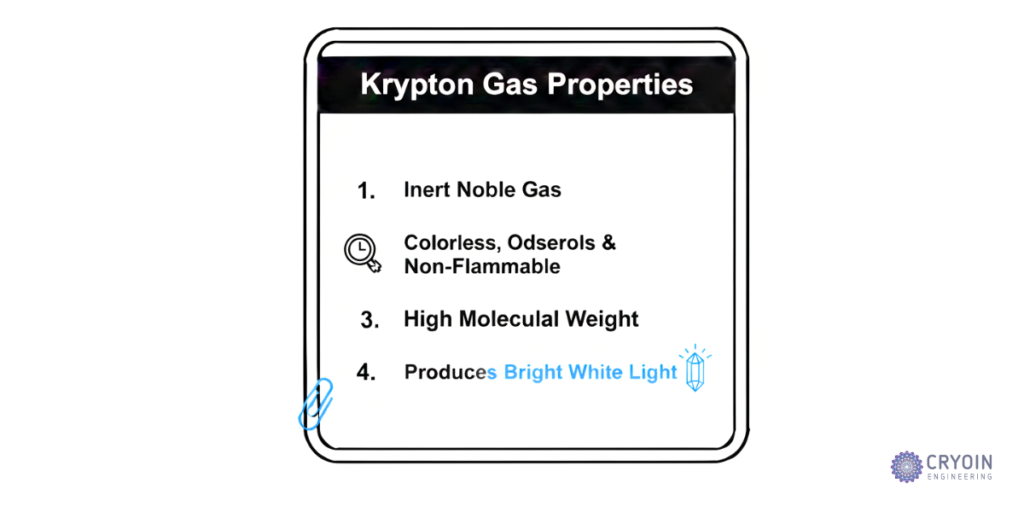
Krypton has a set of physical and chemical characteristics that determine its use in precision and high-technology environments.
- Atomic number: 36
- Atomic weight: 83.798
- Electron configuration: [Ar] 3d¹⁰ 4s² 4p⁶
- Melting point: −157.4 °C
- Boiling point: −153.4 °C
- Density (at STP): 3.749 kg/m³
- Chemical reactivity: Very low
Krypton is significantly denser than air and lighter noble gases, which contributes to its efficiency in high-intensity illumination systems and optical discharge equipment. When electrically excited, krypton emits intense spectral lines, making it suitable for photonic and precision optical applications. While generally inert, krypton can form compounds under extreme laboratory conditions, though such behavior is rare in industrial use.
What Is Krypton Used For?
Krypton is used in applications that require stable light emission, precise optical control, and inert atmospheric conditions.
Lighting and Energy-Efficient Lamps
Krypton is widely used in high-performance lighting, including fluorescent lamps, high-intensity discharge lamps, and energy-efficient incandescent bulbs. Krypton-filled lamps provide improved luminous efficiency and extended operational lifespan compared to conventional gas-filled lighting.
Advanced Optical Generators and Photonics
Krypton serves as a working medium in ion-based optical generators and excimer radiation systems used in scientific research, medical technologies, semiconductor fabrication, and precision optical instrumentation. High-purity krypton ensures stable radiation output and wavelength consistency.
Semiconductor Manufacturing
In the semiconductor industry, krypton is applied in excimer-based radiation systems for photolithography and plasma-assisted manufacturing processes. Ultra-high purity krypton is essential to prevent contamination and maintain precise micro-scale pattern transfer.
Scientific Research and Spectroscopy
Krypton is used in spectroscopy, plasma physics experiments, and calibration standards. Certain krypton isotopes are applied in environmental and geological studies for dating and tracer analysis.
Insulating Gas Applications
Krypton is used as an insulating gas in high-performance window units, where it reduces heat transfer and enhances thermal efficiency. Due to its higher density compared to argon, krypton provides superior insulation in compact glazing systems.
Aerospace and Specialized Engineering
In aerospace and advanced engineering sectors, krypton is utilized in high-reliability illumination systems, sensor technologies, and research equipment where chemically inert gases are required to ensure stable performance under extreme conditions.
Krypton Gas History
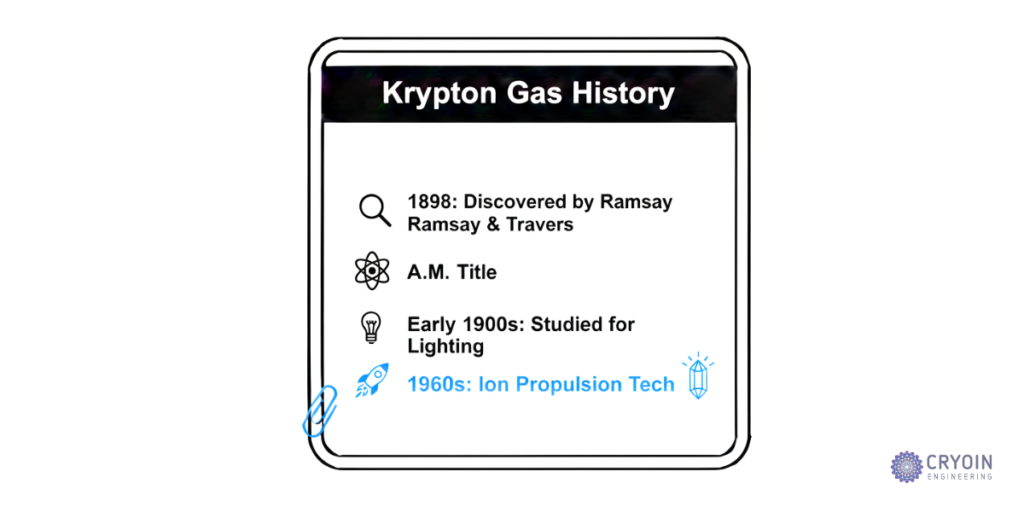
Krypton was discovered in 1898 by William Ramsay and Morris Travers during experiments with liquefied air. The name originates from the Greek word meaning “hidden,” reflecting its trace presence in the atmosphere.
Following its discovery, krypton found early applications in lighting and spectroscopy. Over time, developments in photonic engineering, electronics, and materials science significantly expanded its industrial and scientific importance.
Industrial High Purity Krypton Gas
Many modern technologies require high-purity krypton, as impurities may negatively influence optical stability, plasma processes, and analytical precision.
Cryoin Engineering supplies industrial krypton gas with a high degree of purification suitable for demanding technical and scientific applications.
- Krypton gas with high and ultra-high purity grades
- Advanced purification and analytical quality control procedures
- Worldwide distribution and logistics support
- Supply volumes from laboratory scale to large industrial quantities
- ISO 9001:2015 certification confirming compliance with international quality standards
Frequently Asked Questions
What Is High Purity Krypton?
High-purity krypton is krypton gas refined to remove oxygen, nitrogen, moisture, hydrocarbons, and other trace contaminants. Purity levels typically reach 99.999% or higher depending on application requirements.
How Many Electrons Does Krypton Have?
Krypton has 36 electrons arranged in a stable configuration with a complete outer electron shell.
When Was Krypton Discovered?
Krypton was discovered in 1898 by William Ramsay and Morris Travers.
Why Choose High-Purity Krypton Gas?
High-purity krypton ensures stable light emission, reliable photonic system performance, accurate scientific measurements, and reduced contamination risks in semiconductor processes.
Is Krypton Reactive?
Krypton is chemically inert under normal industrial and laboratory conditions and forms compounds only under extreme experimental environments.

Leave a Reply